Mental Ghost
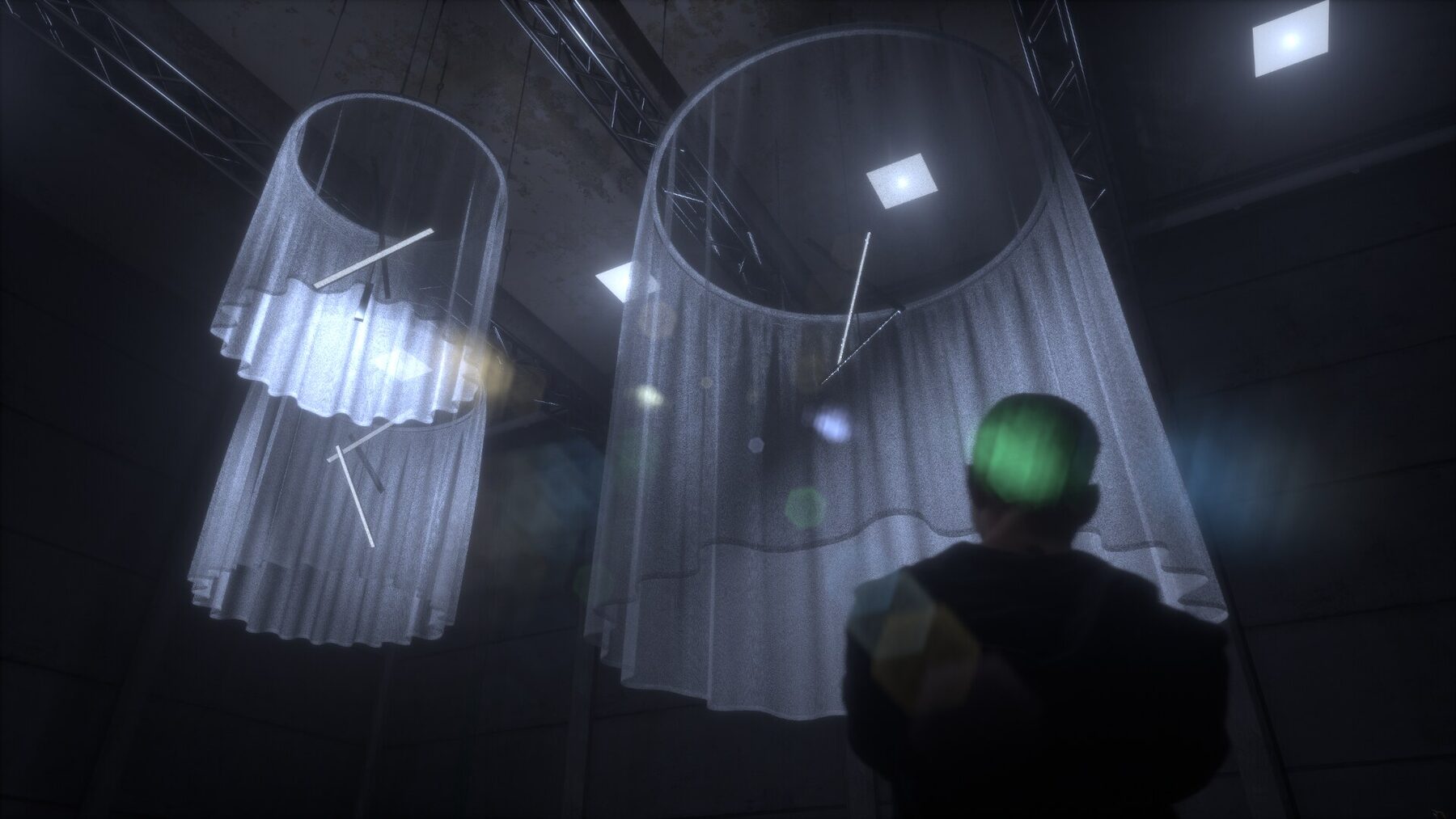
Mental Ghost is an immersive scenography for a live electronic performance, where spatialized sound and light merge into a single living ecosystem.
Linear LED structures, scattered through the stage space, form a suspended network in constant tension. They are wrapped in circular translucent veils, ghostly halos where light diffracts and dissolves. At the core of this luminous matter, loudspeakers diffuse abstract, organic, sometimes grating sound layers, to which the LEDs respond like an overheated nervous system.
The audience is invited to move beneath and around this suspended constellation, immersed in an ever-changing audio-luminous field. Each element answers the others, like fragments of a mind crossed by contradictory signals — an erratic cerebral activity transmitted from point to point, a kind of mental interference turned into stage material.
Approach
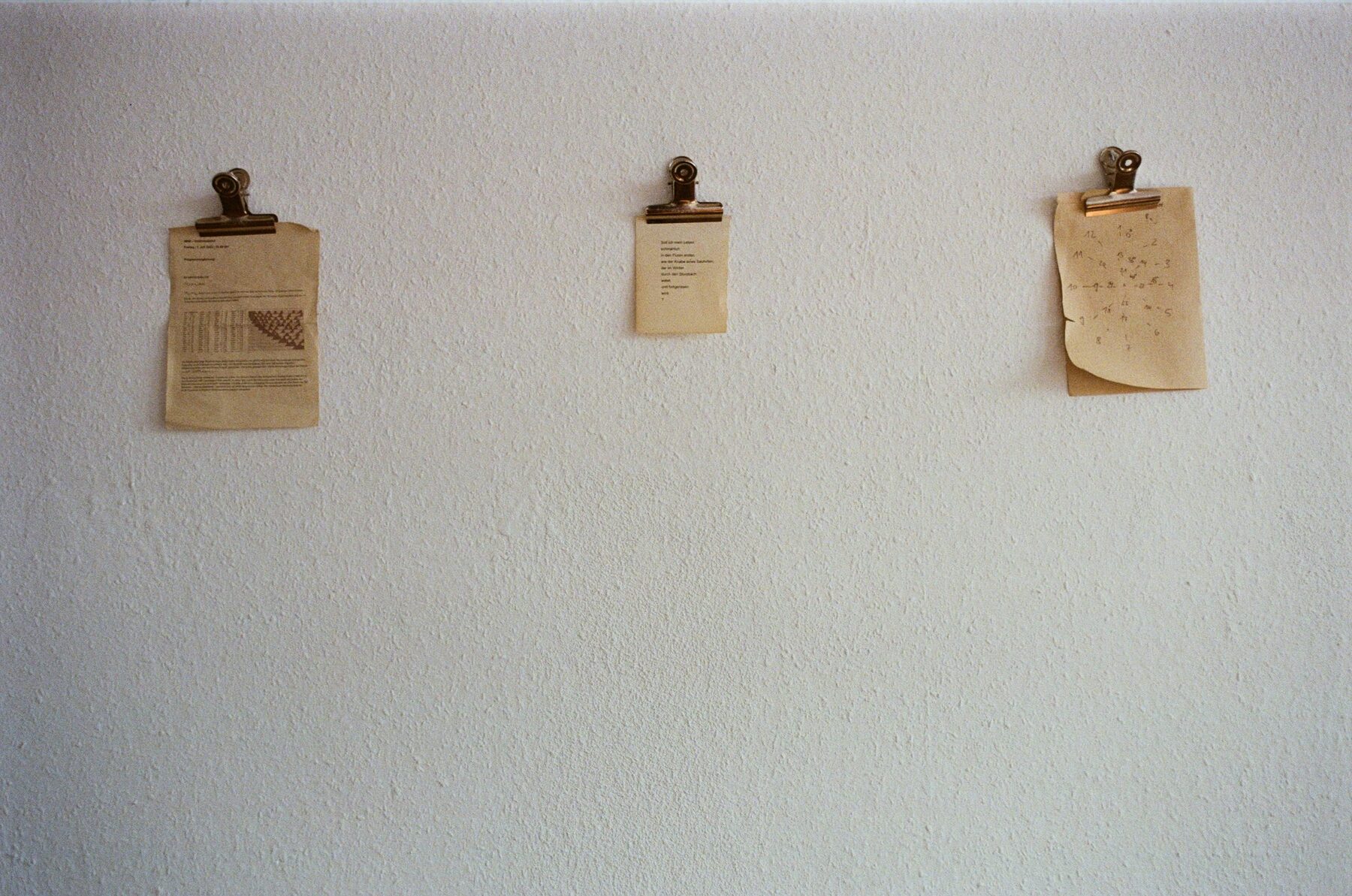
The piece carries an autobiographical dimension, drawing on Eastern European architecture to evoke my Polish origins. By blending old and contemporary materials, it explores the tension between rootedness and adaptation, through the migratory story of my parents, who fled the communist regime in 1980 to rebuild their lives in France.
The scenography borrows architectural elements that marked my childhood — neon tubes and large draped fabrics — observed over many journeys back and forth to Poland. Reinterpreted into a fragmented spatial aesthetic, they become the visual language of an inner disorder, of silent instabilities and invisible resonances. The installation holds this diffuse memory in tension with spatialized light and sound: a conflicted closeness to one’s roots, a bond that endures despite distance, always present yet never entirely stable.
Spatialized sound
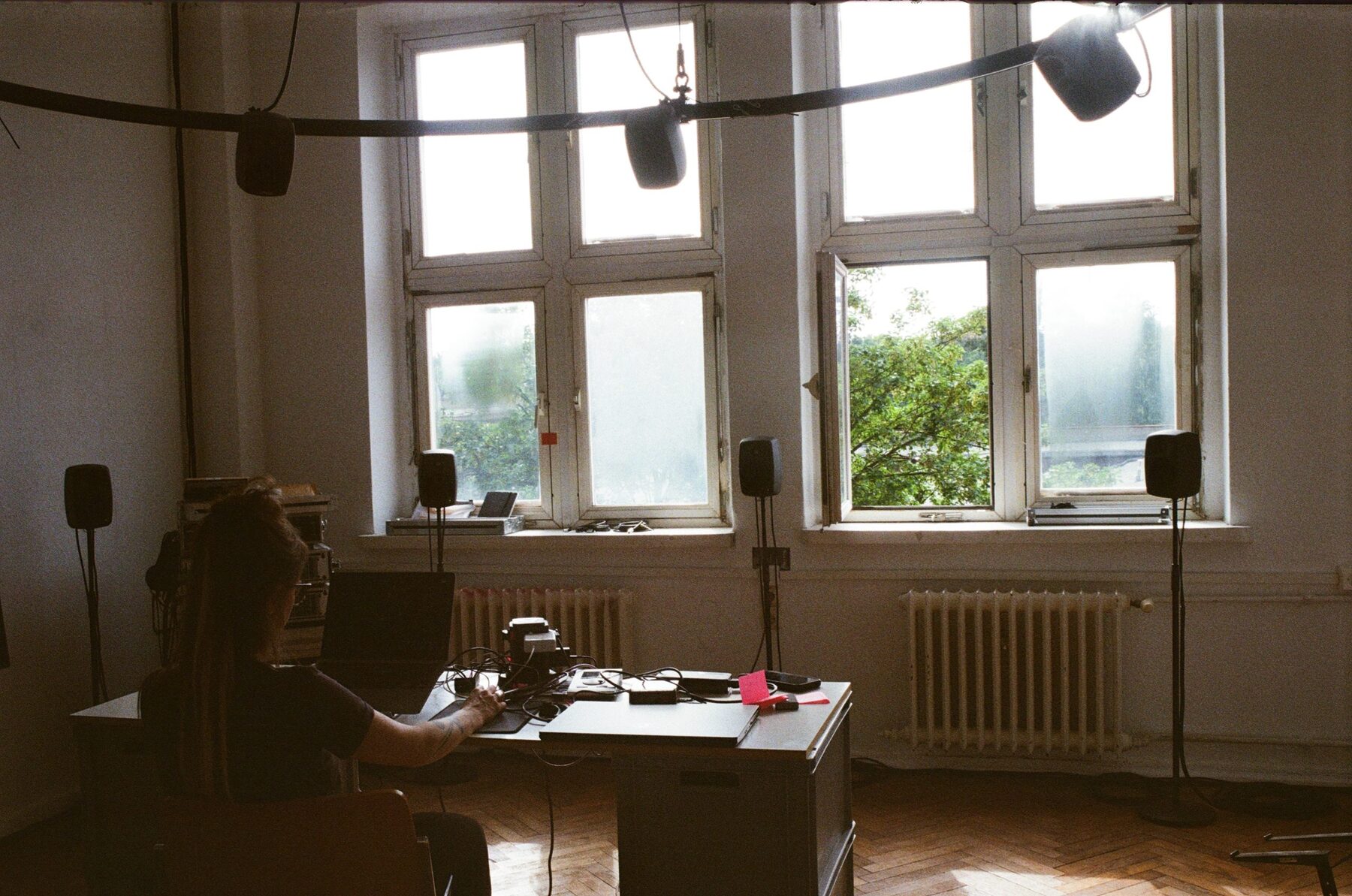
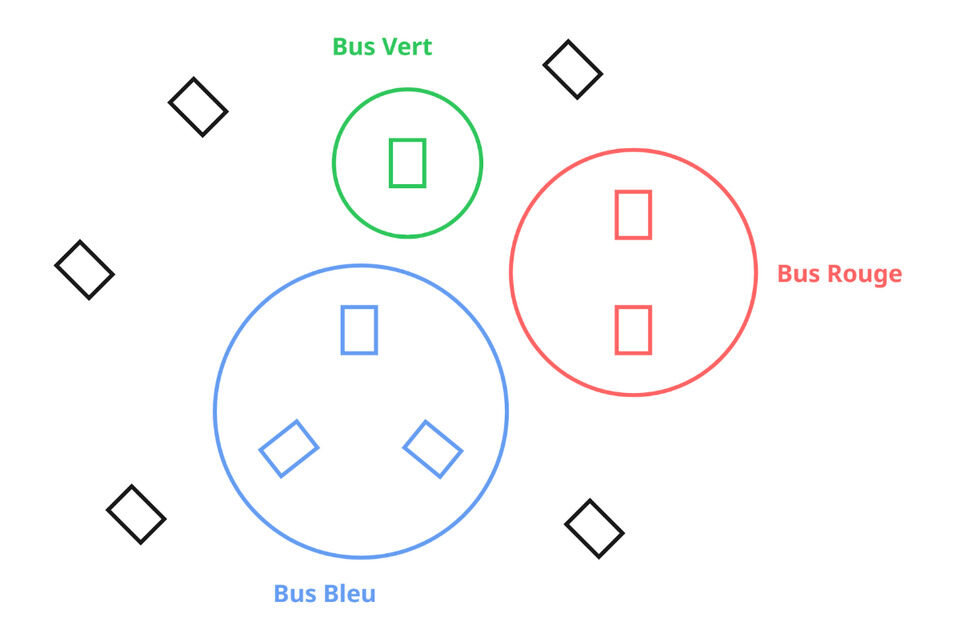
The diffusion system uses loudspeakers positioned exclusively overhead. In circular setups the sweet spot is confined to a narrow zone at the centre of the ring — precisely the space occupied by the performers and their equipment, which leaves only a small part of the audience able to perceive the immersion as intended. Mounting the speakers on the grid keeps the distance between audience and sources far more even across the whole room, and widens the area where the spatialization reads as it was written.
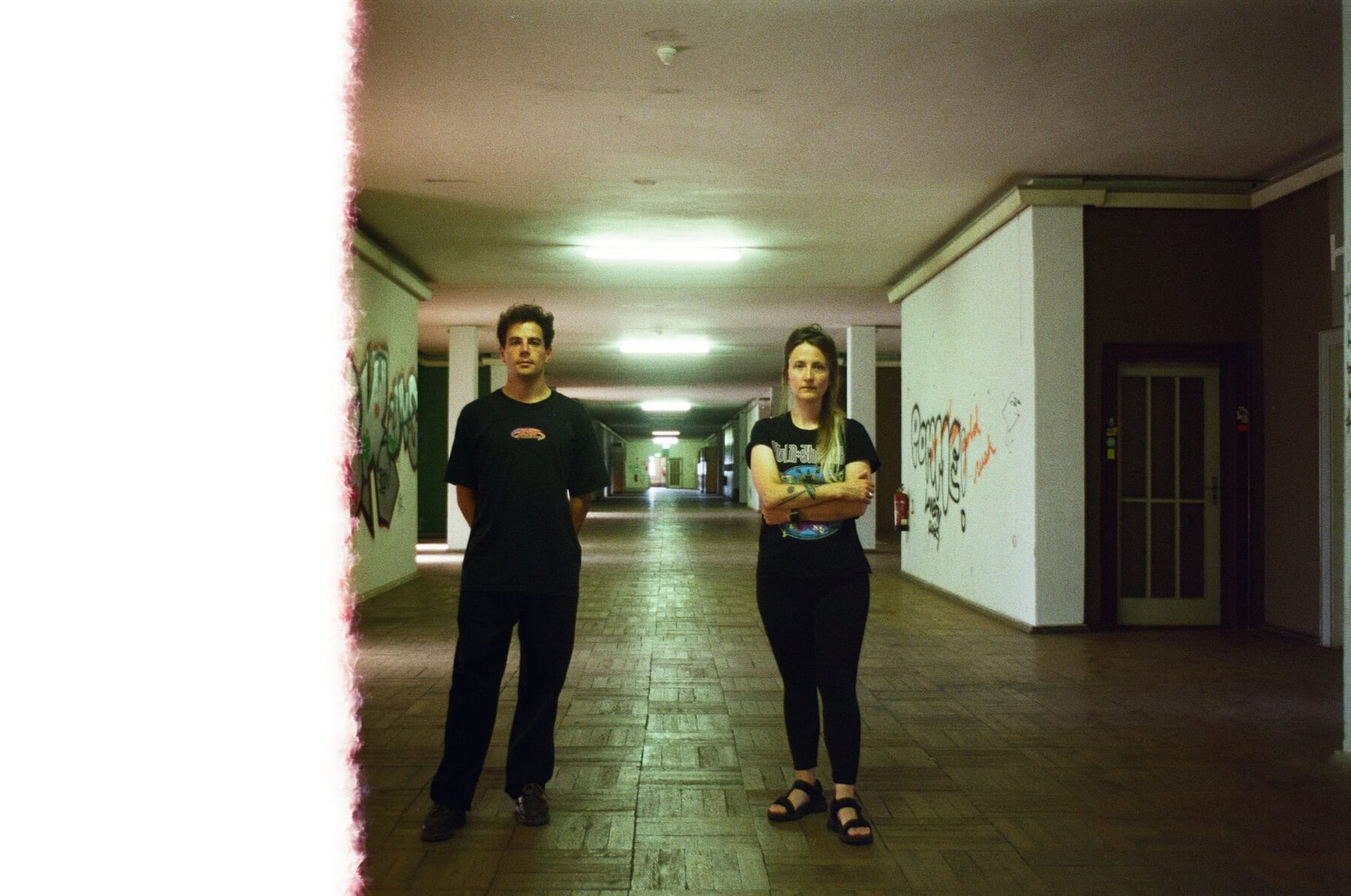
It also frees the centre of the space. Rather than facing a stage, the audience moves through the scenography while the duo performs from two opposite ends of the room. Partially integrated into the set, the loudspeakers visually disappear.
Residencies
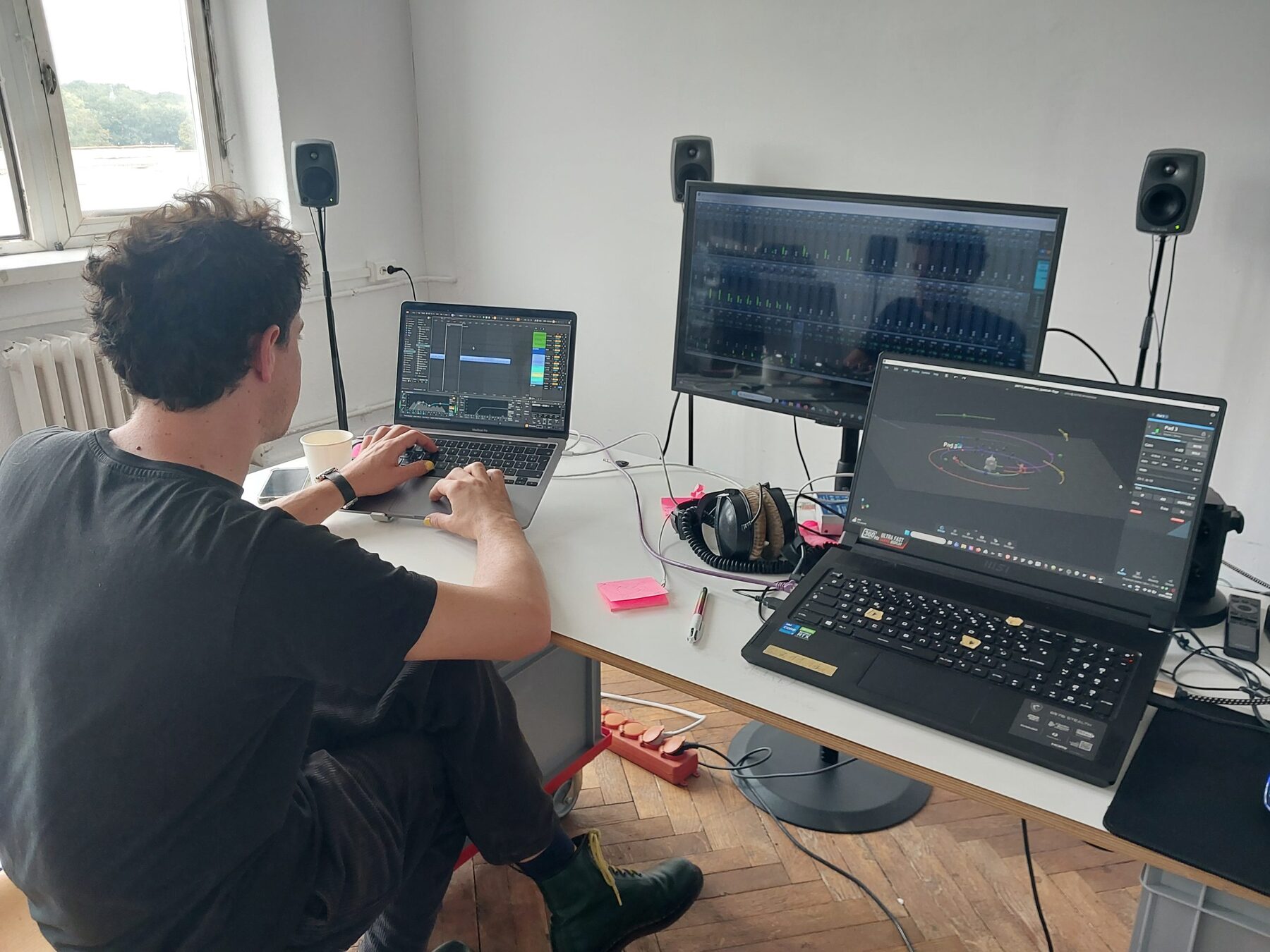
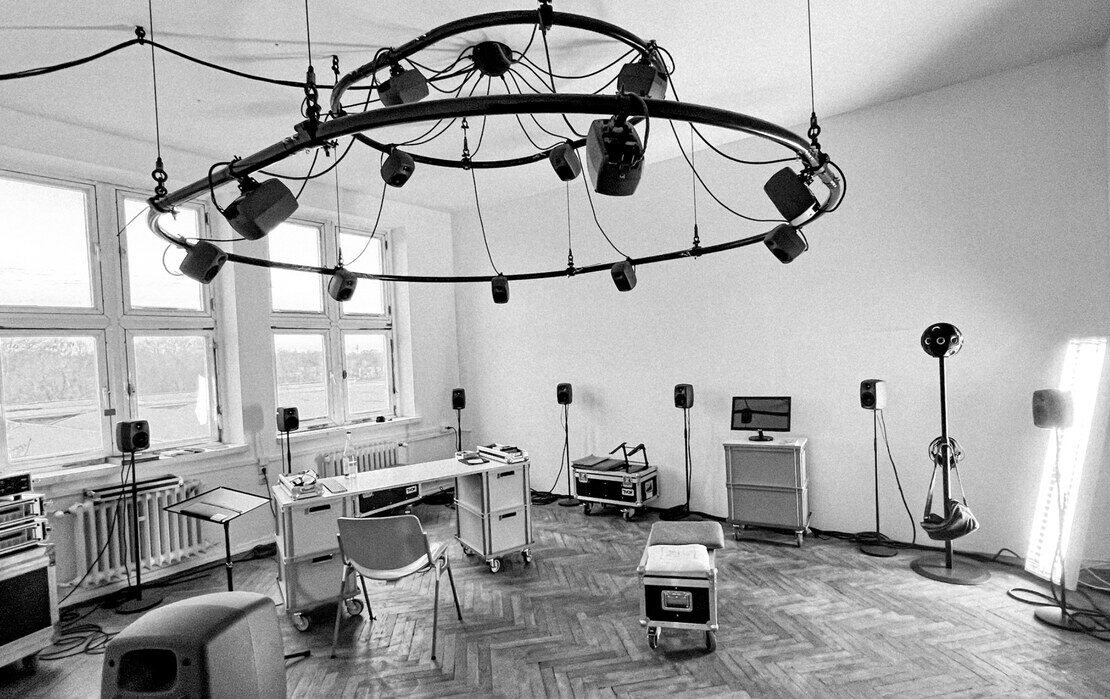
SPÆS Lab, Berlin — two weeks in July 2026 under the laboratory’s modular loudspeaker dome, supported by the European programme Culture Moves Europe. The first sound layer of Mental Ghost was composed there.
Césaré, National Centre for Musical Creation, Reims — one week in March 2027 on their 120 m² modular stage, devoted to the interaction between light and sound and to spatialized diffusion in real conditions.
Technical
Individually addressable LEDs driven by an Advatek controller over ArtNet, sequenced in MadMapper. Ableton Live drives the lighting over MIDI, so each sonic impulse can trigger a modulation of the light. Sound spatialization runs on Holophonix. Three rings of 1.5 m, 2 m and 3 m diameter, wrapped in tulle. Estimated duration: 45 minutes.
A duo project with Vincent Meurisse. Sound references: industrial ambient, digital experimentation and glitch — Aphex Twin, Ryoji Ikeda, Zero Crossing Point.